
I built the tool I could not find.
A trial lawyer’s account of why this exists.
For years I picked juries like everyone else. With sticky notes.
The clerk’s seating chart, a stack of Post-its, and a legal pad for the answers that would not fit on either. That is how I was taught, that is how the lawyer across the aisle did it, and for a long time it did not occur to me that there was anything wrong with it.
What changed my mind was not a disaster. It was a multi‑day voir dire and a paper record that got harder to read every night. What I noticed was how little of what I heard ever made it onto that chart.
A note that says leader is a verdict you reached in four seconds and cannot audit two hours later.
The job is to learn how jurors see themselves, how they see the world, and how the rest of the panel will see them. That is a demanding thing to do in an afternoon, and a sticky note has room for what you decided and none for why. So the deciding runs ahead of the listening. What I had at the end of the day was single words about people I could no longer quote, and six peremptory challenges to spend on them.
I assumed someone had already solved this.
I assumed the problem was solved and I had just missed it. Every other part of trial has software behind it now. Document review, deposition transcripts, presentation, timelines, damages models. Jury selection is the one decision in the whole trial you cannot undo, and it is the one part still being run on stationery.
What I found were tools built by people who had never stood in a courtroom. They assumed lawyers could work a voir dire the way they work a spreadsheet or a brief, at a desk, with time to think. Nothing that worked the way voir dire actually works: fast, out loud, in a room whose shape changes when the judge says so, with a clock running and no chance to go back.
The tool I wanted did not exist, so I stopped waiting for someone else to build it.
The first version was for one trial. Mine.
I am a trial lawyer, not an engineer, so I partnered with a team who had built successful software companies. I told them what a courtroom actually asks of you, and what came back was a tool with one user. It was not a product. It was a seating chart that matched the room I was standing in, a note for each juror that did not run out of space, and a counter that kept track of what both sides had spent.
I used it, then I used it again, then colleagues asked for it. Every feature in JuryBoard exists to fix something the paper method could not. The gallery exists so you can see who fills a seat the moment one empties. The cutoff line exists so you know which of those people can realistically reach the box. Raise‑Your‑Hand and the filters exist so a show of hands takes seconds to record and seconds to find again. The export exists so anyone on your side can see where things stand: at the lunch break, at the end of a day that did not finish, or after the verdict.
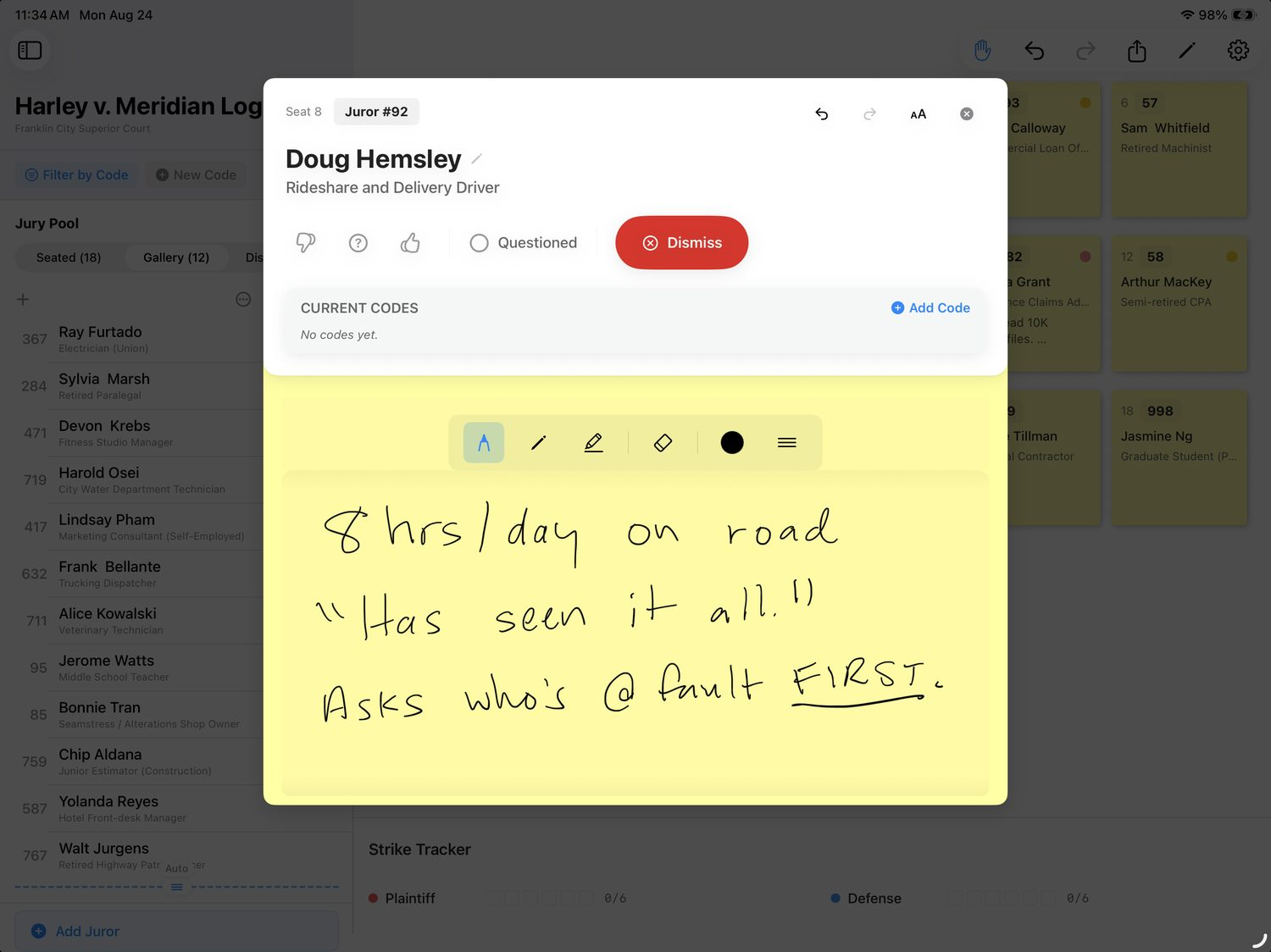
Being the user first shows up everywhere in it.
Software built by people who have never picked a jury tends to solve the wrong problem beautifully. Four things fell out of building this for myself.
It has to be faster than paper
If a tap takes longer than a scribble, nobody uses it in a live courtroom. Speed is not a nice-to-have here, it is the whole test.
It has to work with no signal
Courthouses have thick walls and bad coverage. Anything that needs a network at the wrong moment is worse than a legal pad.
It has to match the room
No two judges run a box the same way. A layout you cannot reshape is a layout you will be fighting all morning.
It has to survive the afternoon
The point is not capture. The point is that what you captured is still usable when the strikes come.
JuryBoard holds what you learn. It cannot tell you what to ask.
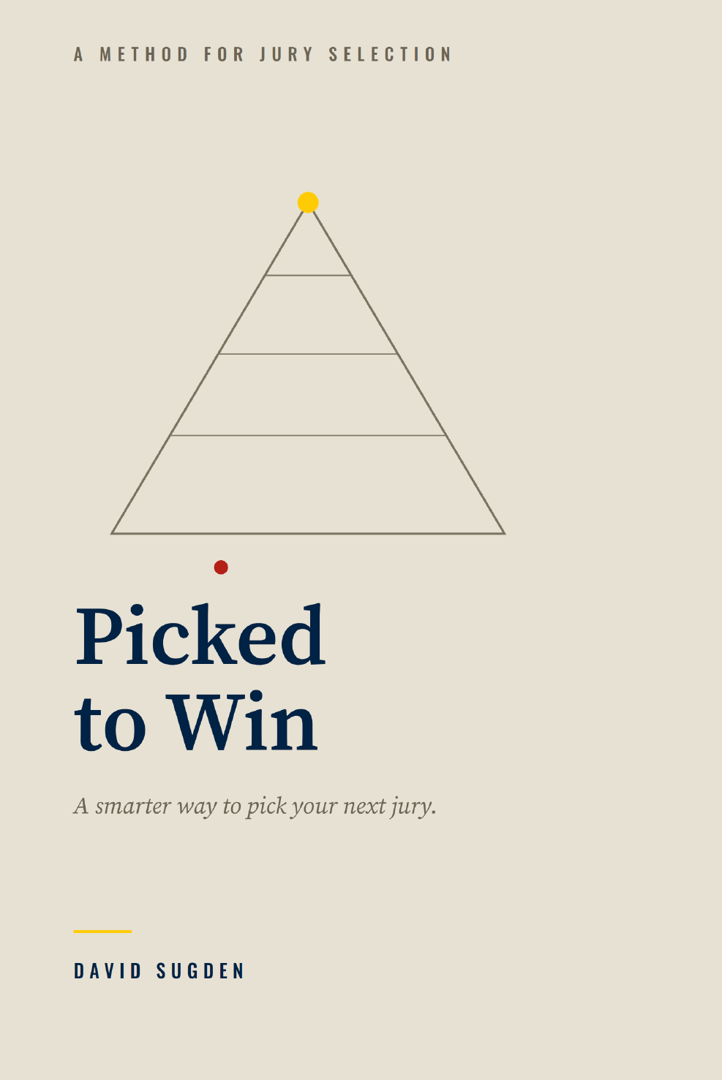
JuryBoard can hold every answer you get. Picked to Win is about getting answers worth holding.
215 pages on what information matters in voir dire, how to draw it out of people trying to be polite in public, and how to judge what you hear. The first eight chapters do not need the app at all.

David Sugden
David Sugden is a trial lawyer. Licensed in California, Texas, and New York, he comes into high‑stakes cases when they cannot settle. He wrote Picked to Win: A Smarter Way to Pick Your Next Jury, a 215‑page method for voir dire, and built JuryBoard to run it.
- Fellowship
- American Board of Trial Advocates (ABOTA)
- Recognition
- Top 50 Super Lawyers in Orange County
- Recognition
- California Trial Lawyer of the Year, The Trial Lawyers
- Teaching
- Founder, Evidence at Trial
Evidence at Trial
Live and online trial‑skills courses for lawyers who want to be better in a courtroom rather than better at describing one. Depositions, expert discovery and examination, and the trial itself, taught by someone who is still trying cases.
Built at counsel table, for counsel table.
Download it free, build the courtroom you actually sit in, and try it before your next trial rather than during it.
Free on iPad, Mac, Windows, and Chromebook. No credit card, no trial clock.