
Picked to Win
You were taught to cross‑examine, to open, to close. Nobody taught you to pick a jury. This book teaches the method: what information actually matters, how to draw it out of people trying to be polite in public, and how to hold onto it until the strikes come.
The sample is 32 pages, includes the full introduction and Chapter 1, and you are welcome to forward it to anyone.
“The jurors did not hide the information that mattered. Most of the time, it was available in the room.”
It went uncollected, or it was collected and lost, because the lawyer had no reliable way to see it, hold onto it, and use it when the decisions came.
That is the argument of the book. Jury selection is not a mind‑reading exercise, a charisma contest, or a ritual to survive on the way to opening statements. It is an information problem, run in a public room, under a running clock, with strikes you cannot get back.
Treating it that way changes the questions you ask, because most questions produce performance rather than information. It changes how you listen, because reasoning predicts deliberations and conclusions do not. It changes what you write down, because a note that says leader will betray you two hours from now. And it changes how you decide, because a strike is never just a removal. It is a trade for whoever comes next.
A method, not a script.
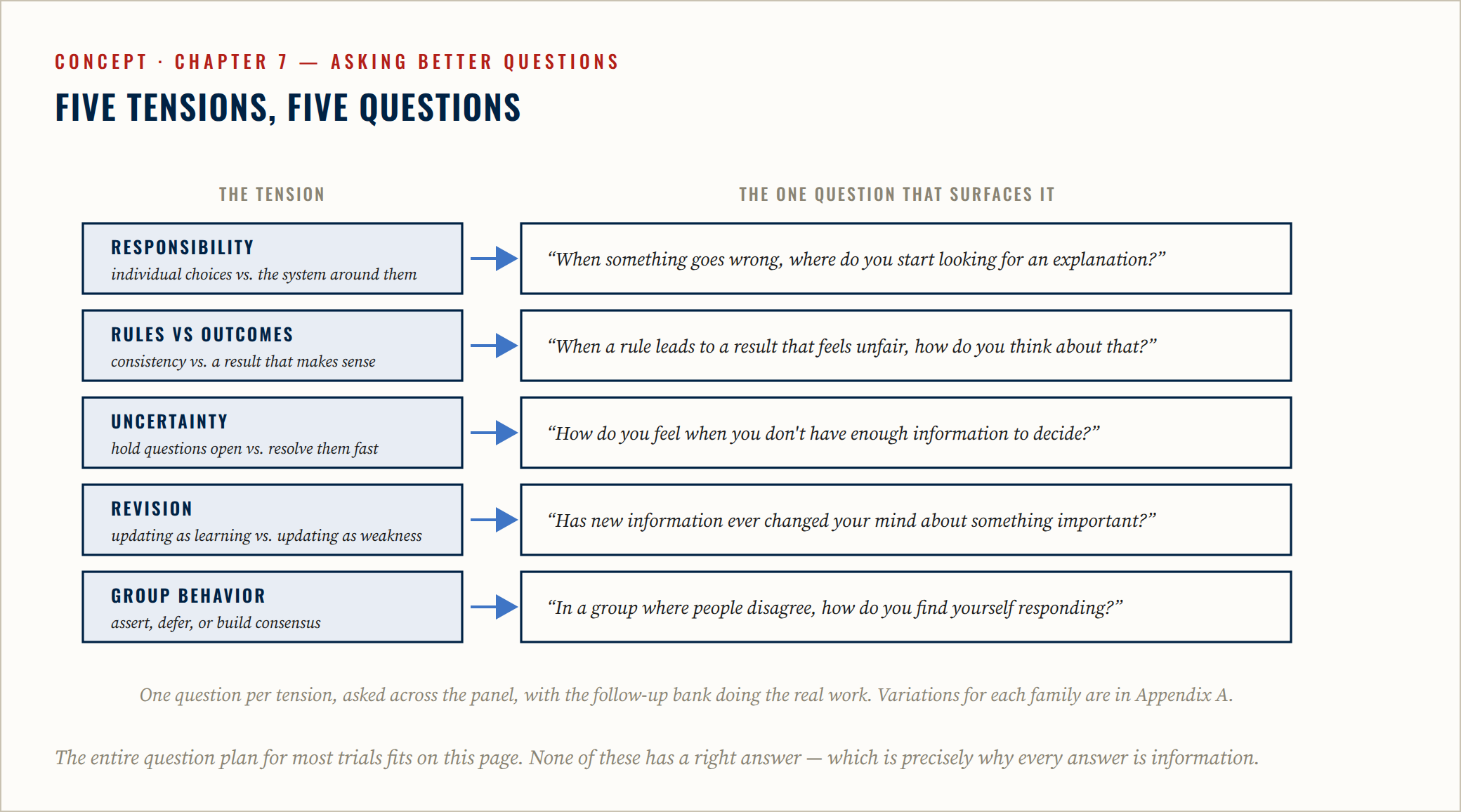
The five tensions that predict deliberations
Responsibility, rules versus outcomes, uncertainty, revision, group behavior. One question surfaces each, and the entire question plan for most trials fits on a single page.
Notes that survive the afternoon
Why one‑word labels fail, what a note has to preserve to still be useful at strike time, and how to keep every show of hands without looking down.
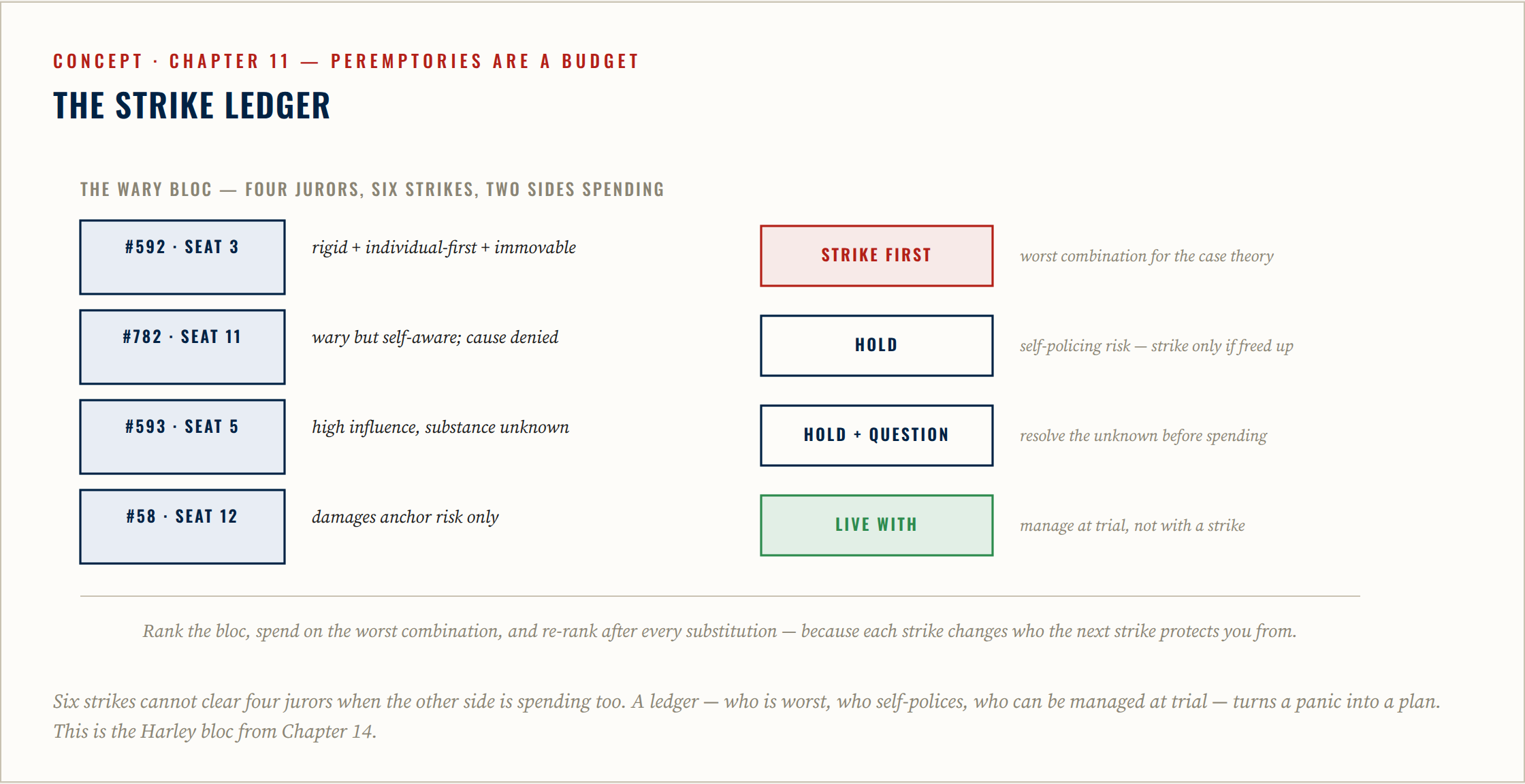
Peremptories as a budget
Rank the bloc, spend on the worst combination, and re‑rank after every substitution, because each strike changes who the next strike has to protect you from.
Why confidence is not insight
The psychology that actually holds up, without the consultants who claim to decode jurors from their shoes. First impressions, working stories, and the reasons truthful jurors still give incomplete answers.
The mistakes on both ends of a career
What young lawyers get wrong from caring too much, and what experienced lawyers get wrong from having seen it all before. Two separate chapters, because they are not the same failure.
One selection, start to finish
Chapter 14 works a complete jury selection in a real case: the panel list, the questions, the notes, the strikes, and the reasoning behind each one.
Six parts, built in order.
What Jury Selection Really Is
- 1Jury Selection Is an Information Problem
- 2The Real Objectives of Jury Selection
- 3The Constraints No One Talks About
The Psychology of Jurors, Without the Nonsense
- 4First Impressions and Cognitive Shortcuts
- 5Beliefs, Identity, and Worldview
- 6Truthfulness, Performance, and Social Pressure
The Mechanics of Effective Voir Dire
- 7Asking Better Questions
- 8Listening Is a Skill
Execution: Making Decisions in Real Time
- 9Before Any Juror Speaks
- 10Listening While the Clock Is Running
- 11Strikes, Substitutions, and the Moment Judgment Is Required
Common Mistakes, and How to Fix Them
- 12What Young Lawyers Get Wrong
- 13What Experienced Lawyers Get Wrong
Putting It All Together
- 14A Complete Jury Selection Walkthrough
- ASample Voir Dire Questions
- BJuror Trait Checklist
- CJury Selection Prep Worksheets
- DQuick‑Reference Guides
The book is built to be used at counsel table.
Every chapter ends in something you can run. Forty‑six diagrams turn the arguments into one‑page references, and the appendices collect the question banks, checklists, and worksheets on their own.
Both ends of the bar, for different reasons.
Start at Chapter 1 and read it straight through.
You will not find a script here, and you will not be told to trust your gut. You will get the actual job broken into parts: what to prepare before anyone speaks, how to ask a question that produces information rather than a performance, what to write down, and how to decide when the clock is running.
Appendix A gives you questions to start from. Appendix C gives you the worksheets to prepare with.
Start at Chapter 1 anyway.
Not because the fundamentals will be new, but because the way you hold them may be. Chapter 13 is written specifically about what experience quietly costs: pattern‑matching that has outrun its evidence, and reads that stopped getting revised years ago.
The most common reaction from experienced trial lawyers is not I never knew that. It is I knew that, and I have been ignoring it for years.
Every method in this book can be run on paper.
JuryBoard was built for the lawyers who would rather not. A seating chart that matches your courtroom, notes that hold the juror’s own words, one‑tap codes that preserve every show of hands, and a strike tracker that does the substitution math while you exercise judgment.
Chapters 8 through 11 show it working a real panel, and Chapter 14 runs one selection from the panel list to the seated jury.
It is free to download and free to use up to a limited number of moves, so you can try it before you spend anything. Buy the book and your first month of JuryBoard is free.
Start with the sample. It is the real first chapter.
- Full introduction and Chapter 1
- Complete table of contents
- 32 pages, PDF
- Yours to forward to anyone
Email required. One message when the sample lands, and nothing else unless you ask.
Send me the sample- All 14 chapters, 215 pages
- 46 diagrams and reference pages
- Appendices A through D
- Complete walkthrough in Chapter 14
- Instant PDF download
- Your first month of JuryBoard free
Purchased through Payhip. Yours to keep, on every device you own. Your first month of JuryBoard is free.
Buy Picked to Win- Distribute to every lawyer in the firm
- Associate training and trial‑team onboarding
- Pairs with Evidence at Trial courses
Firm and team licensing available. Tell us how many lawyers and we will quote it.
Contact us“The lawyers on both sides will write down the same word: fair. By the end of this book, you will hear the difference.”
The book states its psychological claims plainly and without footnotes, because trial lawyers need conclusions they can use rather than a literature review. The sources are collected in the back: Pennington and Hastie on the story model, Kahneman on cognitive shortcuts, Asch and Sunstein on group behavior, Wixted and Wells on confidence and accuracy, and the governing law on peremptories from Batson through California Code of Civil Procedure sections 231.5 and 231.7.